
Geography

Intent
At Preston Candover CE Primary School, we want geography to inspire a lasting curiosity and fascination about the world. From the Early Years onwards, we develop pupils’ understanding of diverse people, places and environments, helping them to recognise the connections between them, understand their own place in the world and become thoughtful, informed global citizens.
In the Early Years Foundation Stage, children begin to develop their geographical understanding through Understanding the World: People, Culture and Communities and The Natural World. Through exploring their immediate environment, our school grounds and local area, children begin to observe, describe and compare places and environments and develop the language and concepts that provide the foundations for later geographical learning.
Across Key Stages 1 and 2, our geography curriculum builds upon these foundations to provide pupils with a coherent and ambitious understanding of their locality, the United Kingdom and the wider world. Pupils develop both substantive knowledge of places, environments, physical and human processes and disciplinary knowledge of how geographers investigate, interpret and understand the world.
We want pupils to:
- develop secure locational and place knowledge and an increasingly sophisticated understanding of scale
- acquire and retain important geographical knowledge and vocabulary
- understand key physical and human processes and the relationships between them
- recognise connections and interdependence between people, places and environments
- develop competence in fieldwork, mapwork and geographical data collection and interpretation
- ask geographical questions, investigate places and processes and communicate evidence-informed conclusions
- make meaningful connections between different places, scales and geographical concepts
- understand contemporary geographical issues, including climate change, sustainability, food, resources and environmental change, and consider how people can act as responsible stewards of the world.
Through rich geographical experiences, pupils encounter diverse places, people, cultures and environments. Local, national and global geography are connected wherever appropriate, enabling pupils to understand their own locality while recognising how it is connected to the wider world.
By the end of Key Stage 2, pupils will have developed a coherent body of geographical knowledge and will increasingly be able to locate, describe, explain, compare, investigate and draw conclusions about places, patterns and processes using appropriate geographical knowledge, vocabulary, fieldwork and evidence.
Implementation
Geographical understanding begins in EYFS through Understanding the World, where children explore their immediate environment, school grounds and local area and begin to observe, describe and compare places and environments.
Across Key Stages 1 and 2, geography is planned over a two-year cycle where appropriate for our mixed-age classes. Our curriculum progression map identifies the substantive and disciplinary knowledge pupils are expected to develop and ensures learning builds coherently from previous knowledge.
Key geographical knowledge and concepts, including location and place, human and physical geography, patterns, change and the interactions between people, places and environments, are revisited and developed with increasing complexity. Pupils progressively develop their disciplinary knowledge through geographical enquiry, fieldwork, interpreting a range of geographical information and communicating their findings. Teachers identify the core knowledge and vocabulary pupils need to secure and make purposeful connections with prior learning.
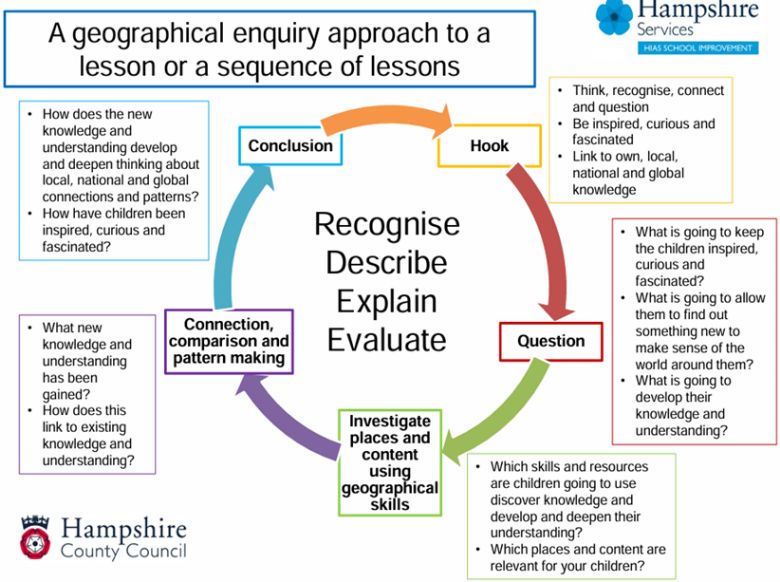
Geographical enquiry is central to our curriculum. Teaching includes purposeful retrieval, explicit instruction, modelling, questioning, discussion and opportunities for pupils to investigate geographical questions, interpret information and reach evidence-informed conclusions. Pupils use a range of geographical sources and tools, including maps, atlases, globes, photographs and digital mapping.
Fieldwork is an integral part of our geography curriculum. Pupils regularly use our school grounds, The Meadow and the surrounding local area to observe, measure, record and investigate geographical features and processes. As pupils progress through school, they develop increasing independence in selecting and using appropriate fieldwork methods, collecting and presenting data and drawing conclusions from their findings.
Visits and experiences beyond the school grounds are used where they add genuine value to geographical understanding and enable pupils to apply their knowledge and skills in real-world contexts.
Teachers are supported to develop their subject knowledge and understanding of effective geography teaching and fieldwork through appropriate professional development, shared resources and subject-leader guidance.
What makes a Preston Candover Geographer?
End of KS1: A Preston Candover geographer knows how to find out about places by asking questions, looking at maps and pictures, and noticing what makes them special.
End of KS2: A Preston Candover geographer knows how to investigate the world by asking questions, using maps and evidence, and explaining how people, places, and nature are connected.
Please use the links below to explore our geography curriculum further: